
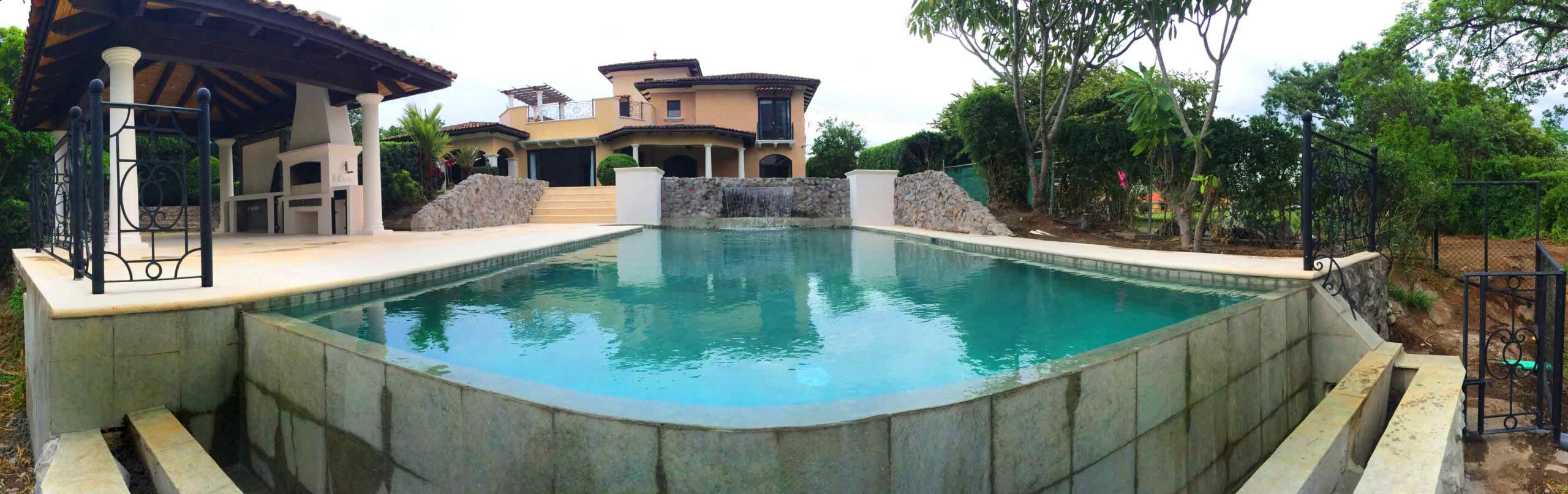
Short answer: an infinity pool has one or more sides where the water spills over the edge into a hidden catch basin or trough . From the right angle, the water seems to merge with the horizon, the ocean or the valley. It makes sense when the site has a slope and a view worth showing off, and when the budget allows for a more complex structure and hydraulic system than a traditional pool.
In Costa Rica, with its valleys, mountains and coastlines, it's one of the most sought-after designs for homes with a view and for hotels.
How it works
- One of the pool walls is built slightly lower than the others, with a perfectly level weir edge .
- Water flows continuously over that edge into a catch troughbelow.
- The trough carries the water to a surge tank.
- The pump draws water from the tank, sends it through the filter and returns it to the pool.
The tank is key: it takes in the water displaced when people get in and the water lost to evaporation, and keeps the system running without the pump running dry.
Types of overflow
- Infinity on one side: the most common; the edge faces the view.
- On several sides: for a more dramatic effect on lots that slope in more than one direction.
- Perimeter overflow: the water spills over all four sides into a grate at deck level. It doesn't need a slope and creates a flush, mirror-like surface, very popular in modern designs.
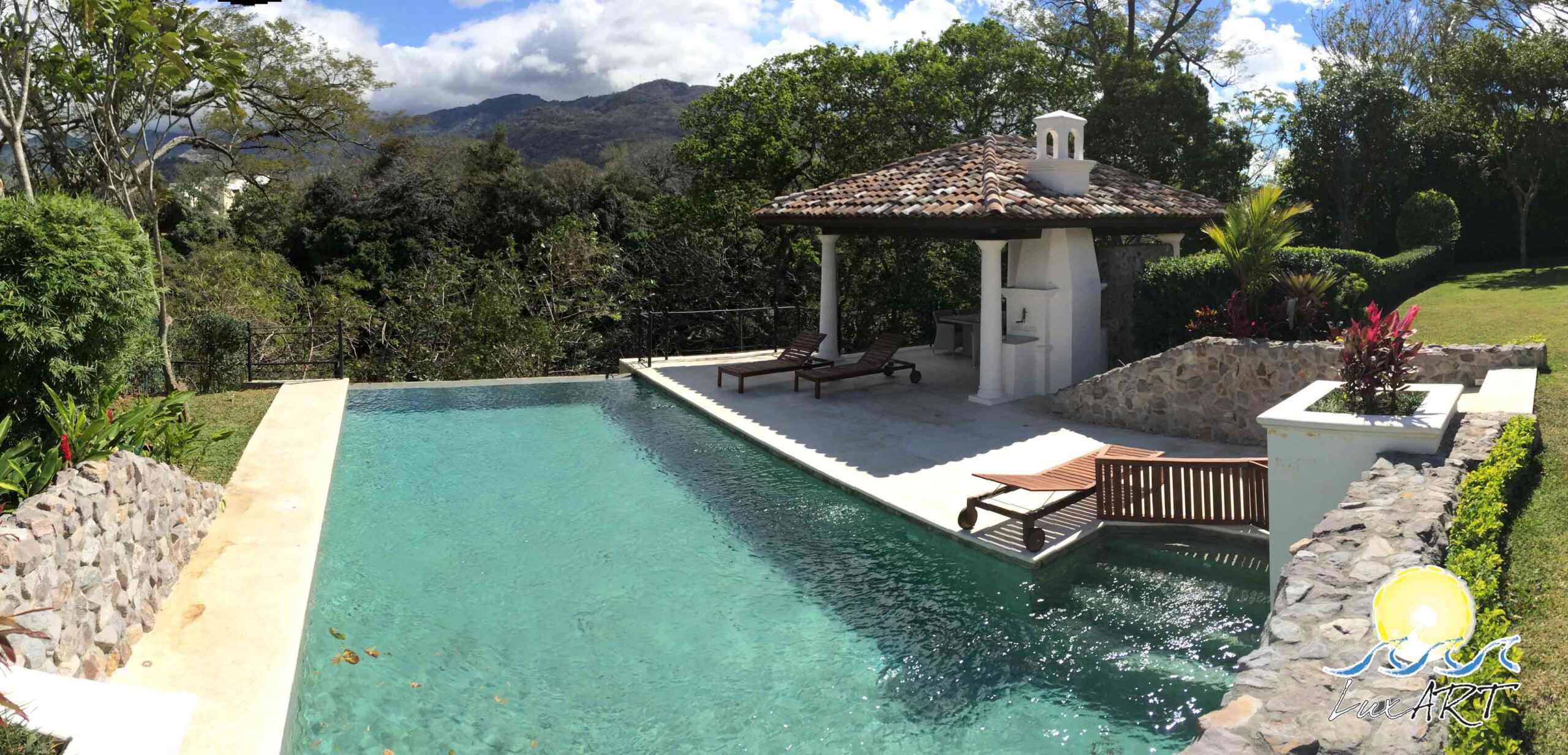
When it makes sense
It makes sense if:
- The site slopes toward a view: the ocean, a valley or the mountains.
- The pool is the centerpiece of the home's or hotel's design.
- The budget allows for a more complex build.
It may not make sense if:
- The site is flat and there's no view (in that case, a perimeter overflow is an alternative).
- There's too little space for the trough and the tank.
- You want the cheapest option to build and maintain.
What makes the build more complex
- Structure: the overflow wall often cantilevers out or sits on sloping ground, and needs careful structural design.
- Exact leveling: if the edge isn't perfectly level, water spills over only part of it and the effect is lost.
- Trough and tank: additional structures that must be waterproofed and sized correctly.
- Hydraulic system: pumps, valves and level controls so the water circulates continuously.
- Finish on the outer wall: the overflow wall is visible too, and is usually clad in mosaic or stone.
For all these reasons, an infinity pool costs more than a traditional pool of the same size.
Maintenance
- More evaporation: the falling water exposes more surface. Water has to be topped up more often; an automatic fill helps.
- Cleaning the trough and the edge, where scale and dirt build up.
- Monitoring the tank level, so the pump doesn't run dry.
- Power use: the water circulates continuously. A variable-speed pump greatly reduces the cost.
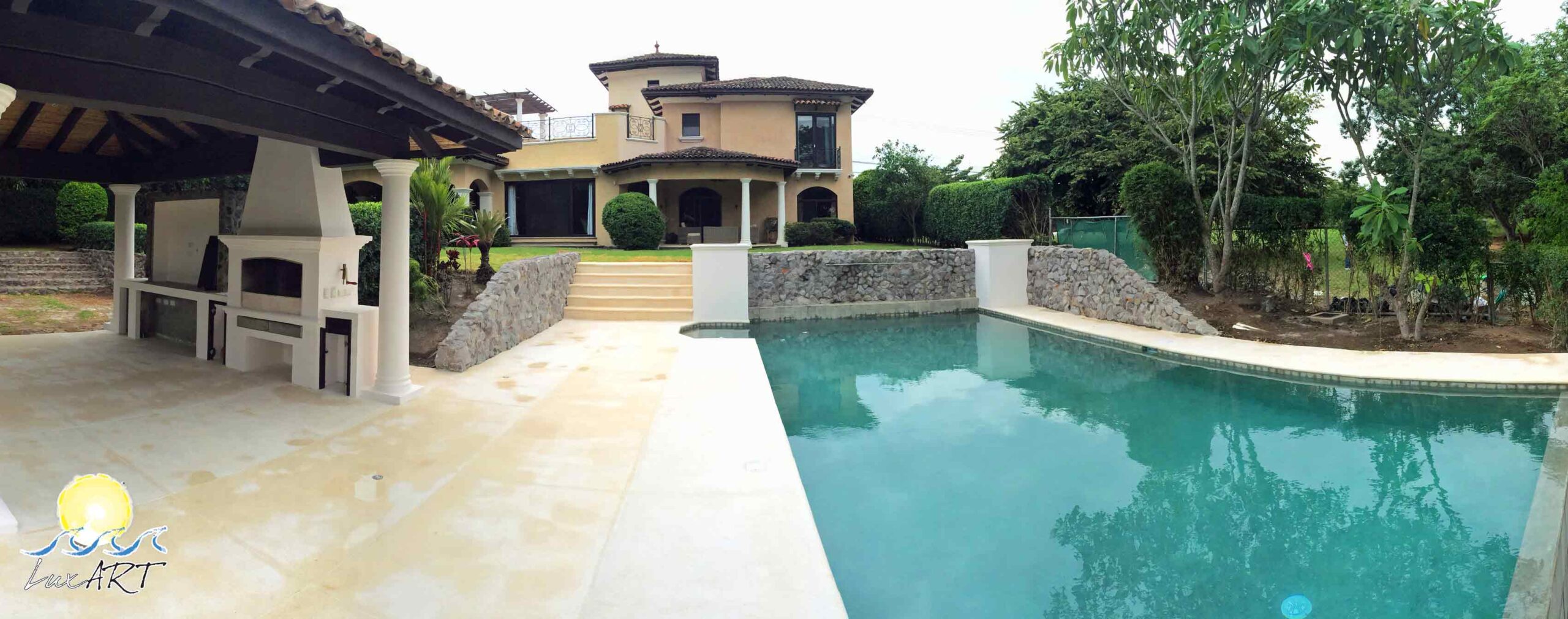
Design tips
- Define the main viewpoint: the effect is seen from the terrace or living room; that's where the edge is positioned from.
- Choose the finish color carefully: dark tones reflect the sky and surroundings; light tones give turquoise water.
- Integrate the lighting: at night, a light on the overflow wall creates a striking effect.
- Combine it with other features: underwater benches, a spa or a terrace next to the edge.
Common mistakes
- Placing the edge without thinking about the view. If the effect can't be seen from where the family spends time, the investment is wasted.
- An undersized surge tank. When many people get in, too much water spills over and the system can't keep up.
- An oversized single-speed pump. It runs many hours a day and drives up the electricity bill.
- Neglecting the outer wall. Over time it gets stained with scale if it isn't cleaned and doesn't have a good finish.
- Forgetting safety. The overflow side can sit well above the ground below; plan for railings or planters at the bottom.
Frequently asked questions
Does an infinity pool lose more water?
Through evaporation, yes, a little more than a traditional pool. The water that spills over isn't lost: it returns to the tank and is filtered.
Can an existing pool be converted into an infinity pool?
In some cases, if the site and the structure allow it. It requires a technical assessment and significant work.
Is it noisy?
The falling water makes a soft, relaxing sound. The design of the trough lets you control how much of it you hear.
Infinity pools with LuxART
At Piscinas LuxART we design and build infinity-edge and perimeter-overflow pools, adapted to the slope and view of each site. See our residential projects and tell us about your property.